
From Water to Market: Fisheries Training Programme Explores New Opportunities for 993 Fish Farmers in Meghalaya
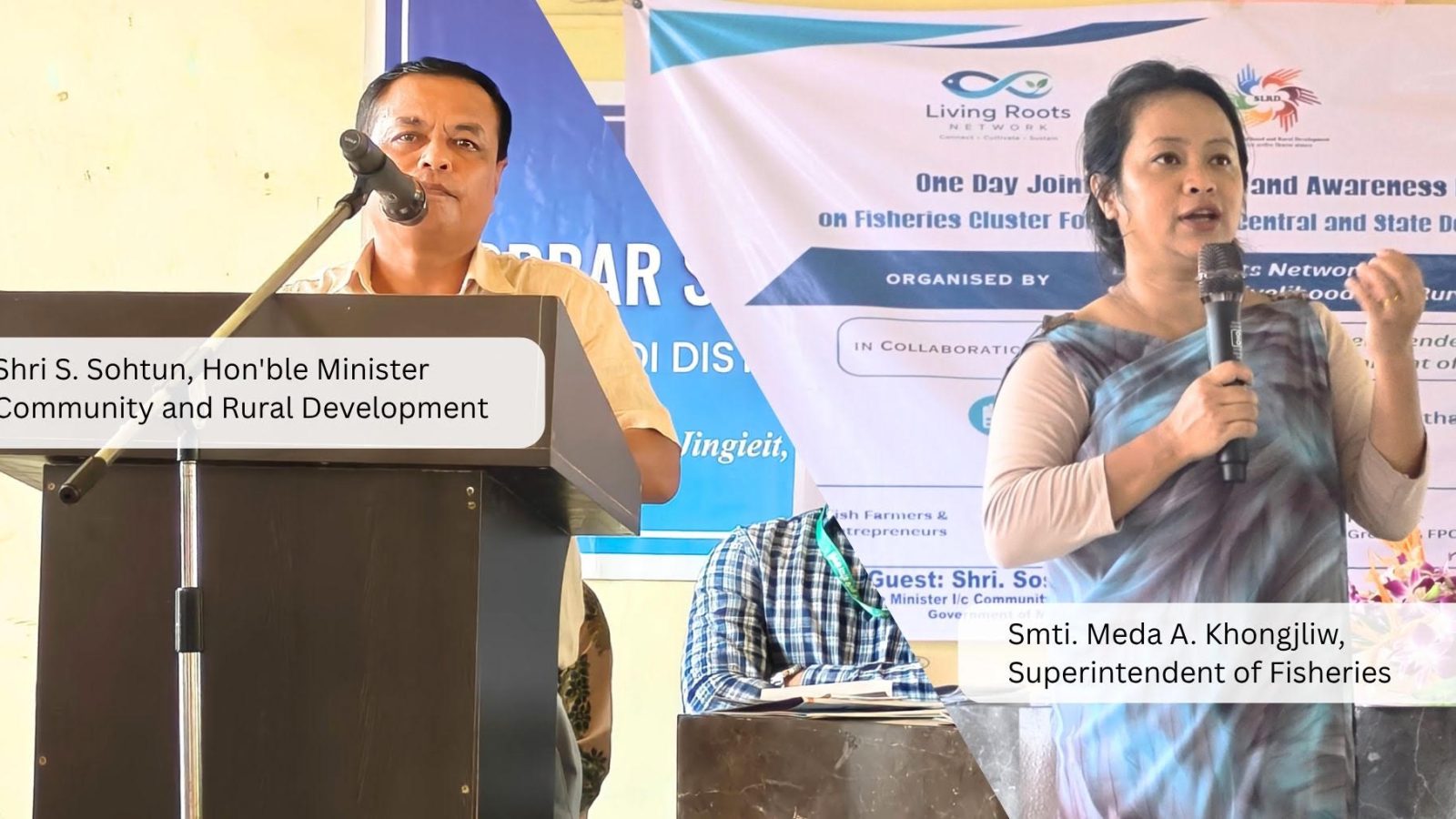
Patharkhmah, Ri-Bhoi District, Meghalaya | 8 October 2026
How can fish farmers improve productivity, manage costs, and connect with better markets?
These questions shaped the One Day Joint Orientation and Awareness Programme on Fisheries Cluster Formation and Central and State Departmental Schemes, held at Patharkhmah, Ri-Bhoi District, Meghalaya, on 8 October 2026.
Organised by Living Roots Network (LRN) and the School of Livelihood and Rural Development (SLRD), in collaboration with the Office of the Superintendent of Fisheries, Ri-Bhoi District, Government of Meghalaya, the programme was held under the theme “From Water to Market: Learn, Connect & Grow.” It focused on practical areas of fisheries development, from scientific fish farming and farm profitability to digital tools, quality management, traceability, and market access.
The programme also discussed the proposed Jirang Fisheries Cluster, which includes 993 fish farmers across approximately 135 hectares of aquaculture area. The proposed cluster aims to explore how collective organisation and coordinated services could help farmers address common challenges and strengthen their fisheries enterprises.
Eight Areas for Strengthening Fisheries Enterprises
The programme flyer highlighted eight connected areas that can help farmers manage their farms more effectively and connect production with market opportunities:
- Scientific fish farming: Quality fish seed, feed, water quality, fish health, and farm records.
- Farm profitability: Input costs, feed conversion ratio (FCR), survival, yield, revenue, and actual profit.
- Digital data management: Digital records for farms, water quality, fish health, harvesting, and sales.
- GIS and fisheries mapping: Mapping water bodies, production clusters, suppliers, roads, and markets.
- IoT and smart aquaculture: Sensors to monitor oxygen, temperature, pH, and water levels.
- Good Aquaculture Practices, quality management, and food safety: Standard procedures, records, and contamination prevention.
- Traceability: Better tracking across seed, farming, inputs, production, harvesting, processing, markets, and consumers.
- Value addition and market linkages: Aggregation, processing, packaging, branding, cold chain, collective marketing, and institutional buyers.
Why a Cluster-Based Approach Matters
Fish farmers can face high feed costs, inconsistent access to quality fish seed, transportation-related seed mortality, disease-management challenges, and limited storage, transportation, and market options. Individual farmers may also have less bargaining power when purchasing inputs or negotiating with buyers.
The proposed Jirang Fisheries Cluster aims to explore collective procurement, technical support, the formation and registration of Fish Farmer Producer Organisations (FFPOs), improved awareness of finance and government schemes, and coordinated harvesting and marketing. These approaches could help farmers access shared services while continuing to manage their own farms.
Ri-Bhoi has nearly 5,000 pond-based fish farmers and ranks third in Meghalaya in fish production, according to the Fisheries Department as reported in the accompanying newspaper coverage. Jirang’s proximity to Assam also offers an opportunity to explore wider markets, provided supply, transportation, and buyer requirements can be coordinated.
Government Schemes and Planned Infrastructure
Participants were familiarised with relevant support mechanisms, including the Pradhan Mantri Matsya Sampada Yojana (PMMSY), Meghalaya Aqua Mission, Fisheries Kisan Credit Card (KCC) facilities, and the Pradhan Mantri Matsya Kisan Samridhi Sah-Yojana (PM-MKSSY). Farmers were encouraged to understand eligibility and application requirements and maintain appropriate farm and financial records.
A feed mill and cold-storage facility are planned for Jirang during October to December 2026 as part of the proposed value-chain intervention. These facilities are planned components and should not be considered completed or operational.
Leadership Emphasises Collective Growth
Chief Guest Shri Sosthenes Sohtun, Hon’ble Minister for Community and Rural Development and MLA from Jirang, encouraged farmers to use government initiatives and develop fisheries as a sustainable source of income. He highlighted the region’s potential in agriculture, fisheries, and allied sectors, and the need to bridge the gap between production potential and actual output. He also expressed support for the cluster-based approach as a way to strengthen fisheries development.
Smti Meda A. Khongiliw, Superintendent of Fisheries, Ri-Bhoi District, also supported the cluster-based approach, emphasising the need to move beyond individual pond-based production towards a more organised fisheries business model that could create economies of scale and improve farmer incomes.
From Water to Market
The one day programme provided a platform to discuss how technical knowledge, digital tools, quality practices, farmer collectives, finance, infrastructure, and organised marketing can work together to strengthen fisheries enterprises.
The proposed Jirang Fisheries Cluster represents an opportunity to connect 993 fish farmers across approximately 135 hectares with a more coordinated production and market system. Effective implementation, farmer participation, technical support, and stronger market connections will be important in translating this opportunity into practical benefits.
993 fish farmers. Approximately 135 hectares. One collective opportunity to build stronger fisheries enterprises and more sustainable livelihoods in Ri-Bhoi, Meghalaya.